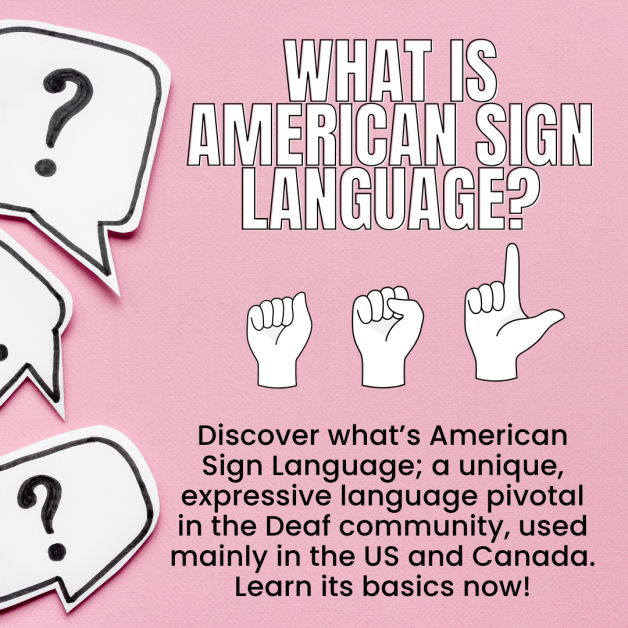
American Sign Language (ASL) is a fascinating and unique language used by the Deaf and hard-of-hearing communities in the United States and parts of Canada. It’s a visual language that relies on hand gestures, facial expressions, and body movements to convey meaning. If you’ve ever been curious about ASL, you’re in the right place! Let’s dive into the basics of American Sign Language and understand its nuances.
American Sign Language is a Language
ASL is a complete and complex language with its own grammar and syntax, distinct from English. Unlike spoken languages, ASL is visual and involves the use of signs made by moving the hands combined with facial expressions and body postures. It’s not just about the hands—every gesture carries meaning, often influenced by the face and body.
The Unique Characteristics of ASL
One of the most fascinating aspects of ASL is that it’s not a universal language. Just like spoken languages, sign languages vary across different regions and cultures. ASL is primarily used in the United States and parts of Canada, and while it shares some similarities with other sign languages, it is distinct in its own right.
ASL also does not have a written form of the language. Although GLOSS is used to represent it, it is not a formal written version of ASL. GLOSS uses English-based words to show ASL’s distinct grammatical structure, and more complex systems like Stokoe notation and SignWriting, used by researchers and linguists to document the language.
The Importance of ASL
ASL plays a crucial role in the Deaf community. It’s not only a means of communication but also a cultural identifier and a way of life for many. Understanding ASL opens up a world of interaction with the Deaf community, fostering inclusivity and bridging communication gaps. It’s a language that can express abstract ideas and nuanced emotions just as effectively as any spoken language.
ASL in Different Countries
While ASL is predominantly used in the United States and Canada, it has also influenced sign languages in other countries. For example, some Caribbean nations incorporate elements of ASL into their own local sign languages. However, it’s important to note that ASL is not the same as British Sign Language (BSL) or other sign languages around the world.
Dialects Within ASL
Just like spoken languages, ASL has its own dialects and regional variations. These differences might arise due to geographic location, cultural influences, or the presence of Deaf communities that have developed their own unique signs. This diversity enriches the language and allows for a wide range of expression and creativity.
Regional Variations in ASL
In the United States, you’ll find that certain signs might differ from one region to another. For instance, the sign for “birthday” or “Christmas” might have slight variations depending on whether you’re in the northeast or the southwest. These regional differences are similar to accents in spoken languages and are a testament to the rich tapestry of ASL.
Learning ASL: A Journey Worth Taking
Learning ASL can be an incredibly rewarding experience. Whether you’re learning it to communicate with a Deaf family member, for professional reasons, or just out of interest, ASL opens up new avenues of communication and understanding. Plus, it’s an excellent way to challenge your brain and learn a new skill.
The Role of ASL in Society
ASL isn’t just a language; it’s an integral part of Deaf culture and identity. Understanding ASL allows for better communication, inclusivity, and understanding between Deaf and hearing communities. It’s a bridge that connects people and fosters a sense of belonging and mutual respect.
ASL in Education and Workplaces
With increasing awareness about the importance of accessibility, many educational institutions and workplaces are incorporating ASL into their programs. Having interpreters, offering ASL classes, and ensuring that environments are Deaf-friendly are just a few ways that society is becoming more inclusive. This not only benefits the Deaf community but also enriches the entire society by promoting diversity and understanding.
Conclusion
American Sign Language is more than just a means of communication; it’s a vibrant and expressive language that enriches the lives of those who use it. By understanding the basics of ASL, you’re taking the first step toward connecting with the Deaf community and embracing a language that is as rich and varied as any spoken language. Whether you’re learning ASL for personal growth or professional development, it’s a journey that promises to be both enlightening and rewarding.